Welcome back to the world of REITs. In Part I, we learned what real estate investment trusts were. In Part II, we learned about the different sectors of REITs. Now it is time to put our money where our mouth is. Let’s invest in REITs.
Because REITs trade on the stock market, you can invest in them much as you would invest in stocks. However, there are slight differences to investing with REITs, and also there are ways that we can leverage these differences.
REIT ETFs. REIT electronic traded funds are bundles of REITs combined and sold as one security on the stock market. The main REIT ETF in the Vanguard Real Estate ETF (VNQ). If you do not feel comfortable (and this is perfectly okay) investing in individual REITs, I would recommend VNQ as an alternative.
Stock vs Bonds
The biggest advantage to investing in VNQ is also its biggest disadvantage. You have exposure to all REIT sectors at once. As we discuss in part II, REIT sectors mostly perform independently of each other. If you have VNQ, your returns will mostly be an average of these sectors. This can be good and bad.
The dividend yield for VNQ is currently about 4%. This is a high yield compared to the S&P 500 ETF (SPY) which is currently 1.4%. However, my favorite REIT, AGNC, pays close to 10%.
What you are paying for with VNQ is time. Your time. You can dollar cost average into VNQ and basically forget about it. With individual REITs, you will have to stay up to date with their sectors and the overall real estate market. VNQ is a great way to get started with REITs.
Dollar-Cost Average and diversification. We can dollar cost average into our individual REITs as well. Dollar-cost averaging is the best way to get a consistent return with investing. This takes the guesswork out of investing.
2021: The Year of the Dividend
Using a platform such as M1 Finance, we can also diversify our REITs, essentially creating our own ETF. Not only does this give us the benefit of hand-picking our favorite REITs and REIT sectors, but this also removes the expense fee that ETFs charge.
When you create a “pie” in M1 Finance, you set what percentage of the pie that each security should attempt to stay at. For instance, if we have 5 REITs in our pie, we can set them all to stay at 20%. When we feed a lump sum of cash into our pie, the money is distributed across the securities. The platform does its best to keep the percentages at the levels we set. So if one REIT is doing really well, it will get less money distributed and the REIT that is doing less well will get additional money. This ensures that the lowest-priced REITs are buying the most shares. Extremely efficient.
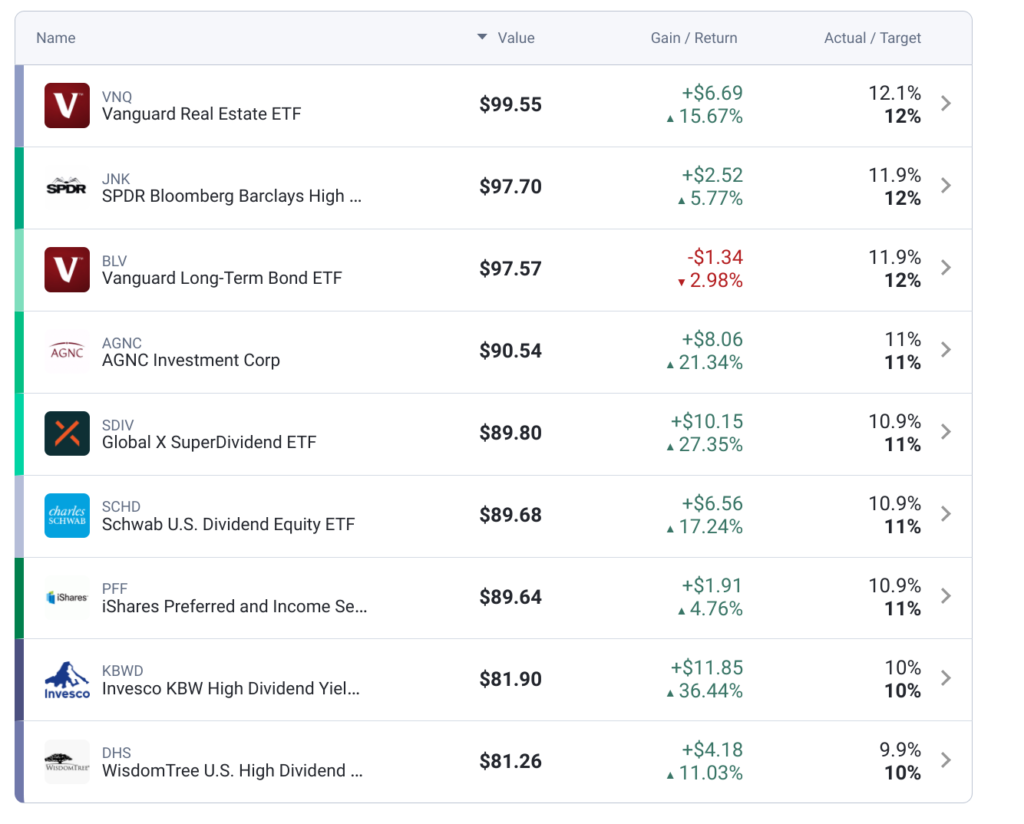
This is a picture of my High Yield “pie” on M1 Finance. You can see both VNQ and AGNC.
Special REIT considerations. REITs have special considerations in addition to normal stocks. REITs are sensitive to the economy like most stocks, however, they are also sensitive to interest rates. If you start to follow interest rates and the 10-year treasury, you will start to learn about their importance to REITs.
5 Habits to Envision a World of Money
Generally, REITs do better in a low-interest-rate environment. Usually, we enter a low-interest-rate environment when the economy is doing badly and needs to be stimulated. This means that the REITs will probably drop in value, then we enter the low-interest-rate environment, and finally, REITs will start to recover. If you can understand this process, there is good money to be made. Ensure you are betting on REITs that will recover. This takes time, your time, to study and learn.
Another way to leverage REITs is by using their Net Asset Value (NAV). Since REITs own property or property paper (mortgages), they have intrinsic value. For instance, say a REIT owns 10 homes for a total of $100,000. They have 20 shares outstanding. At face value, according to NAV, the shares should be worth $5,000 each. If you are tracking the NAV, you may be able to use that information to make a strong purchase. Let’s say the price of the shares fell to $3,000 each.
Stock Market Investing 101
This takes skill. When the economy sours, people will sell shares to get their capital back. If too many shares are sold, then the REIT will have to sell physical properties in order to return the funds to shareholders. When that happens, the NAV will also drop in value.
That is why we need to study. I do all my reading on www.seekingalpha.com. You will need to find contributors that you trust, but once you do, you will be able to read about these special situations. My favorite REIT contributor is Jussi Askola.
Yield on Cost. So, on top of dollar-cost-averaging, you can find these special situations to double down on good REITs at discount. This will ensure that our dividend yield is always as high as possible. The Yield on Cost (YOC) will become valuable information for REITs. This is basically a calculation of the dividend yield based on the price that you paid.
For example, AGNC is currently paying a dividend yield of 10%. But if I purchased it 3 months ago, when the price was much lower, my YOC maybe 15%. The higher the YOC, the more money in your pocket, for a lower price.
The Magic of an Infinite Return
REITs should be bought for the long run. “Buy and hold” is the best strategy for REITs unless something changes your initial investment thesis changes. That could be a change in management or a change in the sector. In March 2020, mall and hotel REIT sectors took a turn for the worst. Be on the lookout for significant changes in your REIT and REIT sectors.
This about wraps up REIT investing. It is very similar to investing in stocks. However, there are some differences that we can also use to our advantage if we are willing to put in the work. By using dollar-cost-averaging, searching for special situations, and maximizing our yield on cost, we should do very well in the REIT category of investing.
Next, we will take a look at Fundrise. Following that, we will look at the two REIT ETFs, VNQ and HOMZ.
Check out our Merchandise Shop on Redbubble: (here)
Follow us on our Facebook Page (here)
Join our Facebook group (here)
Follow us on Pinterest at:
https://www.pinterest.com/kingmarine/military-family-investing/Disclosure: I am not a financial advisor or money manager, and any knowledge is given as guidance and not direct actionable investment advice. I am an Amazon Affiliate. Please research any investment vehicles that are being considered. I wrote this article myself, and it expresses my own opinions. I am not receiving compensation for it. I have no business relationship with any company whose stock is mentioned in this article.


Leave a Reply