Do you want to get a paycheck while you are relaxing on the beach? How about receiving money while you are traveling on an airplane? These scenarios can be the result of successful dividend investing. Dividends are a portion of the profits of a company that you own stock in. The basic idea of investing in dividend stocks is to receive enough dividends so that they can pay for your lifestyle. Yes, it is very possible. Yes, it will take a lot of money. No, it is not a passive way of investing. It will take knowledge and time to continually pick worthy dividend stocks. Over the course of this article we will start with the basics of dividend investing, how it differs from the capital appreciation method, what is dividend growth investing, and finally what a solid dividend portfolio might look like. When you are finished reading, you will be a little more confident in dividend investing, however, don’t rush out and start buying stocks. I highly recommend reading “The Intelligent Investor” by Benjamin Graham before you invest any money. This book will give you all the key phrases you will need to survive in the stock market, as well as prepare you mentally for the rigors of investing. Let’s start with the basics.
Dividends are a portion of the company’s profits; given out to shareholders. Not all companies pay a dividend. When you research a company on Yahoo Finance, look for the block that says dividend or yield. It will be a dollar amount or a percent. You will have to study each layout on different websites. Some websites list the dividend as the quarterly payout, others list it as the annual payout, and others just list the dividend yield as a percent. Let’s take my favorite dividend stock AT&T (T). Its stock price is $31, the quarterly dividend is $0.52, the annual dividend is $2.08, and its dividend yield is 6.78%. You can get the dividend yield by dividing the annual dividend by the stock price (2.08/31). Another way to look at dividend yield is if you invested $100 in stock, your annual dividends received would be the dividend yield. So if I invested $100 in T, I would receive $6.78 in annual dividends. That is a quick way to see where the stock stands against others when it comes to dividends. However, when buying dividend stocks, the dividend yield is one of the last things you want to look at.
If the last paragraph confused you, good, that means you are exactly where you are supposed to be. The world of dividend investing is complex and never-ending. You do not want to feel that you know it all. You have to constantly stay on your toes. The main item you want to research when buying dividend stocks is dividend safety. At any point, a dividend stock can cut its dividend. This usually happens when things get tough and the economy is in a recession. You have to pick solid companies with a track record of paying dividends. A good place to start is a list of Dividend Kings and Dividend Aristocrats. These companies have been paying dividends for a very long time. This is where I would start my dividend journey. Usually, a high dividend payout for a company can be a sign of trouble. Dividend yields between 2-4% are standard. When you get above this (for non-REITs) there could be trouble. T has a dividend yield of 6.67%, does that mean the company is in trouble? Not really, but the company has a lot of debt. I understand this and I keep abreast of the situation. As I said earlier, you have to know what companies you are investing in and stay up to date with these companies. I stay up to date via the website www.seekingalpha.com.
After a few years of dividend investing, I have come up with my own personal investing method. I love investing in older, blue-chip companies that pay nice dividends. But, I also know that they may not be around another 50-70 years. I like to also buy younger companies that are just starting out on their dividend journeys. For example, I recently had $1000 that I wanted to spend for dividends stocks that pay in August (more on that later). I could receive the most income from investing the whole amount in T stocks. However, I divided the money among a wide variety of stocks that pay various dividend yields. I bought Apple, Ally Bank, AT&T, CVS, and Starbucks. Not only did I get a total dividend yield of about 2.5%, but the stocks have appreciated in value as well. When you start researching dividend investing, most people will say that capital appreciation does not matter, that you are only here for the income. I started out my journey thinking this. However, I watched all my dividend stocks sitting red for many months, and it is not a good feeling. I started a new combined way to invest in capital and dividends, but I will cover it in Stock Market Investing 103. You will definitely want to invest in stocks that pay dividends and also rise in the stock price. Think of it like investing in a house. The value of the house should appreciate and also the amount of rent charged should rise as well. In the case of dividend stocks, if possible, you want the price of stocks to rise as well as the amount of dividends received. Not every stock can work this way, however, by doing a lot of research, you can get pretty close to have a great mix of capital appreciation and dividend payout.
Most dividend stocks pay dividends quarterly. They are grouped like this: Group #1 (Jan, Apr, July, Oct), Group #2 (Feb, May, August, Nov), and Group #3 (Mar, Jun, Sep, Dec). I like to try to buy an even amount of stocks to get a consistent payout throughout the months and years. There are also some stocks and REITs that pay monthly. These are a good way to build up your base amount of income. I use monthly paying ETFs to build a nice, consistent return. Then I add the dividend-paying stocks on top of these. That is just what I do, you can build whatever portfolio works for you. That is why so many people love dividend investing; because you have the flexibility to achieve your goals in any way that you want. You will not get this kind of freedom in a 401k or TSP portfolio. I will cover the different types of dividend-paying equities later. Following that, I will post a picture of my M1 finance spreadsheet. Yes, keeping a spreadsheet is a must for dividend investing. Consider dividends like paychecks you receive every month. If you received a paycheck and you were missing some hours, you would know immediately. The same here. You want to know what is going on with your stocks. You want to know if dividends have been suspended or canceled, and also if you received a special dividend (an amazing thing!). Here are some of the different equities that pay dividends or interest:
Stocks: These are companies that usually sell products. Some examples are Apple (AAPL) and Microsoft (MFST).
Bond Funds: These are electronic funds that buy and hold bonds of different types. They pay interest not dividends. The payments will look the same but they will be taxed differently. Some examples are BLV and TLT.
Electronic Traded Funds: If you would like dividends but don’t want the hassle, you can buy a high dividend ETF. They specialize in buying companies that pay dividends. The dividend yield is usually around 3.5% – 4.5%. Not bad, but you will not get as much capital appreciation as with buying individual stocks. Some ETFs are PFF, KBWD, and DHS.
Real Estate Investment Trusts: REITs specialize in holding real estate. There are tons of sub-categories of REITs, so you will want to diversify amongst those. REITs, by law, have to pay a high portion of their profits out to shareholders. This guarantees a high dividend payout. Some REITs are AGNC, IRM, and MPW.
Mutual Funds (Open-ended): Mutual funds are like index funds but they are actively managed by a manager. Open-end funds can add shares as more people buy into the funds. The fees are usually higher, but I like to keep a small portfolio of mutual funds. They do very well in stock market crashes because they only trade after hours. This means that they do not get caught up in the hysteria of the day. I particularly like one high dividend mutual fund called ARTFX.
Closed-End Funds: Closed-End funds start with a set amount of shares, and do not make more shares available as more people try to buy-in. They are different in that they trade on the stock market like ETFs. They can be bought above or below NAV (net asset value). They mostly use leverage as well, meaning the returns are higher but the risk is higher as well. I keep a stable of 3 closed-end funds; PCI, UTG, UTF.
Preferred Shares: Preferred are a great way to get substantial dividend gains, but they are in a world of their own. They are hard to find, and you need to know exactly what you are looking for. I have about $500 worth of preferred shares and will be buying more when prices are lower. If you want to start researching preferred shares, I recommend reading the book “The Billionaire’s Secret” by Herbert Tabin.
Now that you know some of the basics of dividend investing, how does it differ from the Capital Appreciation Method? As you can remember from the Stock Market Investing 101: Capital Appreciation Method, this method grows your wealth rather quickly. The caveat is that you would sell shares of your investments in order to fund your lifestyle. By investing with dividend investing, you would fund your lifestyle from the dividends you receive, with no need to sell the underlying assets. Chances are that you would reach your goal faster with the capital appreciation method. However, you would constantly be in fear of your capital disappearing. Let’s take to similar doom and gloom scenarios, one using the capital appreciation method, and the other using dividend investing. For scenario one, you are using capital appreciation and have amassed $1,000,000. A pandemic hits and your fortune instantly turns into $600,000. Now you can either sell your shares at a reduced rate or live off of your bonds or emergency fund. The smart thing to do would be to wait until your shares appreciated in value before you sold again. Now, in scenario #2, you are using dividend investing. You have amassed $1,000,000 and pays you $40,000 annually in dividends. A pandemic hits and half of your dividend stocks stop paying dividends. This still leaves you a $20,000 annual income. You can then use some bonds and emergency funds to subsidize your lifestyle. The important thing is that you are not selling anything and yet still receiving income. This is an important distinction between the two methods. I feel that you have way more control over your income with dividend investing. And let’s not forget that you can sell some dividend stocks if you need income.
Josh, what is dividend growth investing? Dividend growth investing also takes into account the growth of each company’s dividend payment. For example, let’s say company ABC pays $2.00 annually. Then the following years $2.10, $2.22, $2.35, $2.40. This means that your dividend is actually beating inflation. In the capital appreciation method, your shares are going up in value. However, you are not receiving very much income from them. With dividend growth investing, your shares are probably going up in value but your dividend payments are going up and beating inflation as well. If you had 100 shares of ABC your annual payouts would look like this: $200, $210, $222, $235, and $240. By year 5, you would be making almost 20% more in dividends than year 1. And you wouldn’t have invested any more money into the shares. There is a whole underground following of dividend growth investing. I personally do not worry about it too much. As long as my stocks are appreciating as well as paying great dividends, I am good to go. However, it is nice when you get a dividend pay raise. You feel as though you received a small promotion at work. The dividend growth followers are a unique group and most are super hardcore. It is awesome to follow them, just don’t go too crazy with them.
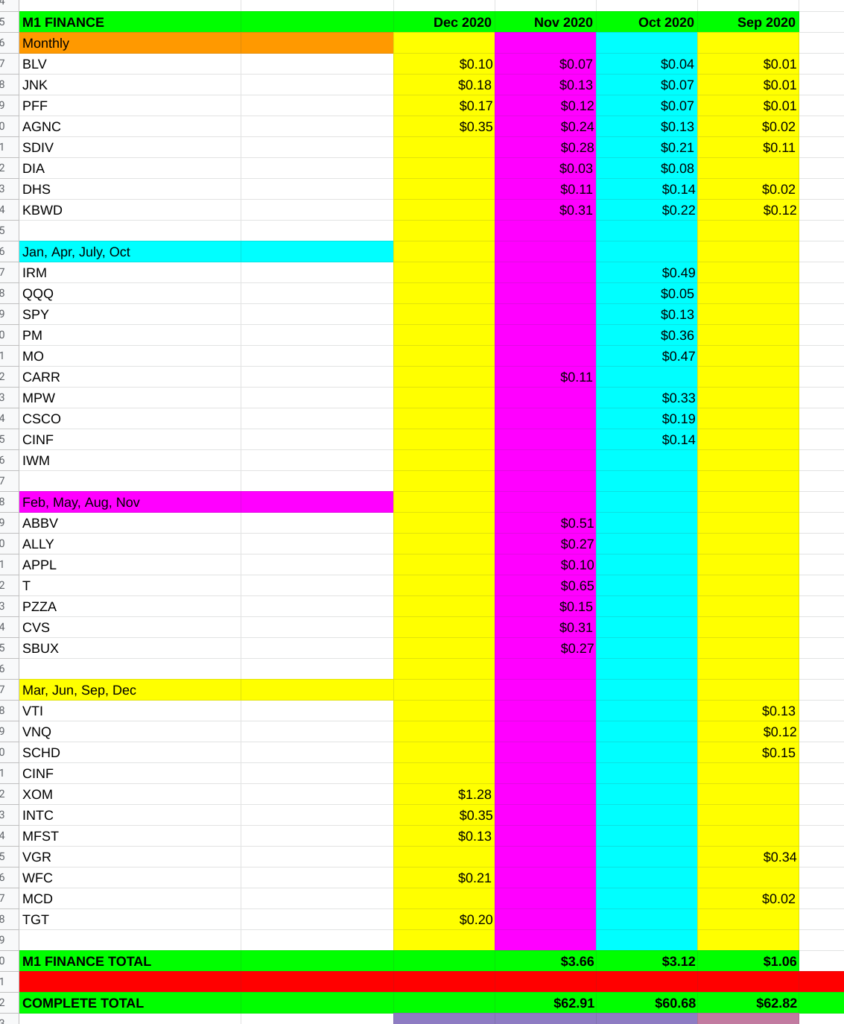
This is my spreadsheet from my M1 Finance portfolio. The month of December 2020 has not finished, so we can’t really do a great comparison. However, you can see that I have everything separated by monthly, Group #1, Group #2, and Group #3. If you want to learn about dividend growth investing, print this picture out. Next to each stock ticker, write the dividend yield, what sector it is in (i.e. consumer staples, energy), and current price. This will help you decide if I have the correct balance of up-and-coming dividend stocks and if I am diversified. I will go more into my stock portfolio in Stock Market Investing 103: The Appreciation/Dividend method. This method helps mitigate the downfalls of both methods and combined will hopefully get us safer returns while keeping solid income. Stay tuned for the next in the Stock Market Investing 101 series. Please comment and share this article. Also, join my mailing list on the right side of the page.
Follow us on our Facebook Page:
https://www.facebook.com/kingmarine1775
Join our Facebook group at:
https://www.facebook.com/groups/231490384820780
Listen and Learn on YouTube:
https://www.youtube.com/channel/UCfoq4ILMCmesrmO_HXE53Jg/
Follow us on Pinterest at:
https://www.pinterest.com/kingmarine/military-family-investing/Disclosure: I am not a financial advisor or money manager, and any knowledge is given as guidance and not direct actionable investment advice. I am an Amazon Affiliate. Please research any investment vehicles that are being considered. I wrote this article myself, and it expresses my own opinions. I am not receiving compensation for it. I have no business relationship with any company whose stock is mentioned in this article.
Leave a Reply